
Why Hill Country Pools Turn Green So Fast (and How to Stop It)
June 12, 2026 · Clean Pool Squad
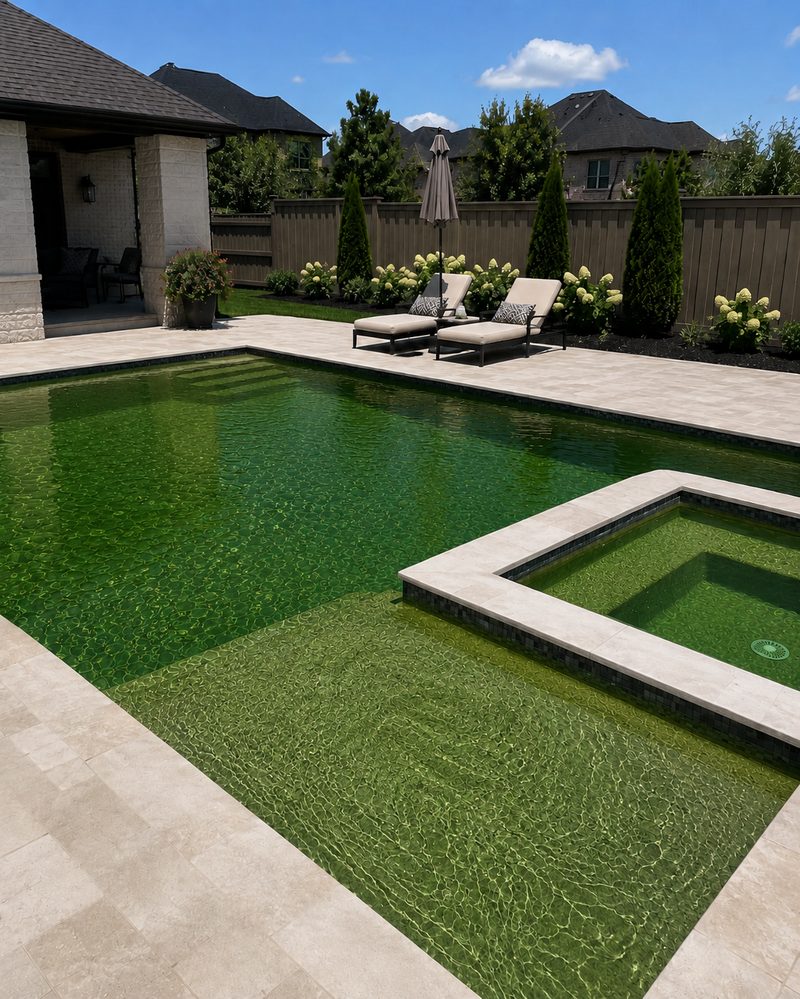
Every summer, the same call: "The pool was fine on Friday. By Monday it was a pond." If you've owned a pool around Dripping Springs, Bee Cave, or Southwest Austin for more than a season, you've probably lived it. Pools here genuinely do turn green faster than the national average, and it isn't bad luck. It's four local factors stacking on top of each other.
1. Texas heat burns chlorine like fuel
Algae is always in your pool, waiting. Chlorine keeps it suppressed — but heat and ultraviolet light destroy chlorine. At 95–105°F water-warming weather, a pool that held sanitizer comfortably in April can burn through its entire reserve in a single July weekend. Once free chlorine touches zero, algae doubles every few hours. That's why "fine Friday, green Monday" is chemically accurate, not an exaggeration.
2. Hard water handcuffs your chemistry
Hill Country water comes out of limestone. It arrives loaded with calcium, and high calcium pushes pools toward scale — cloudy water, rough tile, clogged heater exchangers. Fighting scale often means running chemistry in ranges that leave less margin for error on sanitizer. A pool with thin margins tips faster. (Wimberley well-water pools have it hardest — more on that on our Wimberley page.)
3. Cedar, oak, and everything they drop
Cedar pollen in winter, oak catkins in spring, leaves in fall. Organic debris does two bad things at once: it consumes chlorine as it decomposes, and it clogs filters so circulation drops. Less circulation means dead spots — the still corners behind ladders and on steps where algae establishes its beachhead.
4. The silent equipment failure
The fastest green pool isn't chemical at all — it's mechanical. A pump that quietly died on Tuesday means zero circulation and zero chlorination until someone notices. In August, that's a swamp by Saturday. Most homeowners check their water; almost nobody checks their pump weekly. (We do — it's part of every visit, and why our repair work usually starts at "small fix" instead of "replacement." More on that at our pool repair page.)
The prevention routine that actually works
You can absolutely keep a Hill Country pool clear year-round. The routine isn't complicated — it's just relentless. Test water twice a week in summer, not once. Keep stabilizer (cyanuric acid) in range so the sun doesn't strip your chlorine by noon. Brush walls and steps weekly even when they look clean, because algae is invisible until it's a colony. Clean the filter before pressure rises 8–10 PSI over clean baseline, not after. And glance at the pump every few days — listen for it, look at the pressure gauge, make sure the basket isn't packed.
Miss a step for a couple of weeks in July? It happens — vacations, work, life. That's the honest case for weekly service: it's not that homeowners can't do this, it's that the pool doesn't take weeks off. Our weekly plan covers all of it, with a photo report so you see the result without standing over it.
Already green? Don't drain it yet.
A green pool almost never needs draining. Our Green-to-Clean recovery takes most pools from swamp to swim-ready in 3–7 days with aggressive treatment, daily visits, and a proper filter teardown. Draining is the last resort — and when it genuinely is the cheaper path, we'll tell you straight.
Green pool? Tired of almost-green?
Free quotes for weekly service and green pool rescue across Dripping Springs, Bee Cave, Lakeway, Wimberley & SW Austin.